




A 2024 press release marked VR’s shift from being understood mainly as a card to operating as a platform for the full workday. Its portfolio spans food and meal benefits, mobility, people management and financial services, all presented through the SuperApp. The strategic point is less about adding categories than connecting them around the same employer and worker relationship, rather than asking either side to navigate disconnected products.
 VR’s scale is what makes this design matter. It serves more than 110,000 employers and 4.7 million workers through a network of over 589,000 accredited establishments. Its online store lists more than 589,000 accredited establishments across Brazil. At that size, the platform coordinates funding, acceptance, security and support across millions of everyday transactions while keeping the benefit easy to use.
One Employer View of the Benefit
SuperPortal brings together more than 35 integrated solutions, giving employers a single place to control benefits, digital HR services, transport and related programs. For a benefits team, that means worker registration, card delivery locations, orders, payments and reports can sit inside one workflow instead of moving among spreadsheets, email threads and separate supplier screens and approval trails.
The mechanics behind this promise are visible in VR’s training materials. Beneficiaries can be registered by administrators, delivery points allocated, cost centers established and orders placed or monitored online. The online store also facilitates automated funding, payment processing and reporting, with credits guaranteed to be loaded onto a card within 24 hours of an order.
Management visibility is given equal emphasis. VR’s blog and marketing materials describe dashboards with comparative data, decision support and anti-fraud technology. The SuperPortal also allows a lost or stolen card to be blocked and a replacement request inside the system. Those controls give clients a clearer record of what was ordered, issued and changed, while reducing the distance between an exception and its resolution, including card replacement.
Giving Choice in the Worker’s Hand
For workers, the experience starts with direct access to the benefit itself. VR Multi brings separate balances for food, meals, mobility and home office onto one card, while employers choose the mix that fits their policy.
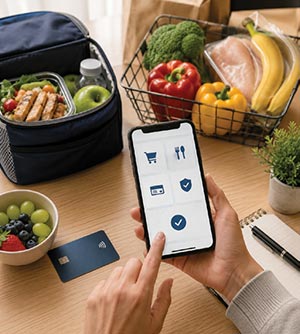
The SuperApp turns that card into a live account. Workers can check balances, review spending, locate accredited establishments and manage card security from a phone. The app also supports QR code, payment link and virtual card transactions. A lunch purchase, grocery run or lost-card response can begin from the same interface, giving employees immediate information before they contact HR or wait for an administrator.
The card choice depends on employee usability. VR’s acceptance network covers markets, bakeries, restaurants and other food outlets nationwide. Its network search helps workers find nearby options, while merchant tools allow participating businesses to track payment status. The model works on both sides. Employers issue the benefit centrally while employees spend it locally, and merchants can see whether a transaction is pending, paid, canceled or expired in the app.
VR differentiation lies in bringing employer control and worker choice together within a single benefits experience. SuperPortal takes care of the process of configuration, order handling, reporting and data and security management. SuperApp provides employees with information about balance, transactions, places of acceptance and payment methods. VR Multi ensures that each category of benefits is separated but available on one card.
From Fragmented Processes to Connected Benefits
Selletiva Assessoria, an insurance advisory firm, offers a clear view of how VR’s model supports hybrid work. Before adopting VR, they dealt with a less flexible time-control process and limited information visibility for employees and managers. By pairing food and meal benefits on one broadly accepted card with online time registration, Selletiva gave employees more practical choices while giving managers a cleaner way to oversee work across locations and schedules. The card is not just a simple benefit by itself, but links the two real issues of spending and attendance.
TIS Tecnologia offers a second view of integration. The company had fragmented benefit, document and time processes and no structured time-control system. After adopting VR, they centralized those functions in one platform and gave workers app access to vacations, payslips and time records. The case shows why VR’s food-benefit offer stands apart. The card participates in a wider information flow rather than ending at payment or a monthly funding file.
Where Scale Proves Everyday Value
Adoption statistics show that the environment is utilized much more often than just checking cards now and then. The company has more than 12 million SuperApp users per month and more than one billion entries through Pontomais. These statistics prove the constant use of the very same digital rails where benefits are delivered. Frequent use gives the platform a demanding test of availability, clarity and performance under sustained daily demand.
Recognition as Top Food Benefits Platform in LATAM 2026 follows from that combination of reach and system behavior. VR gives employers a controlled route from enrollment to funding and reporting, then gives workers broad acceptance, multiple balances and direct account access. The award stands as an outcome of adoption, reliable execution and a food-benefit model built for daily use.

